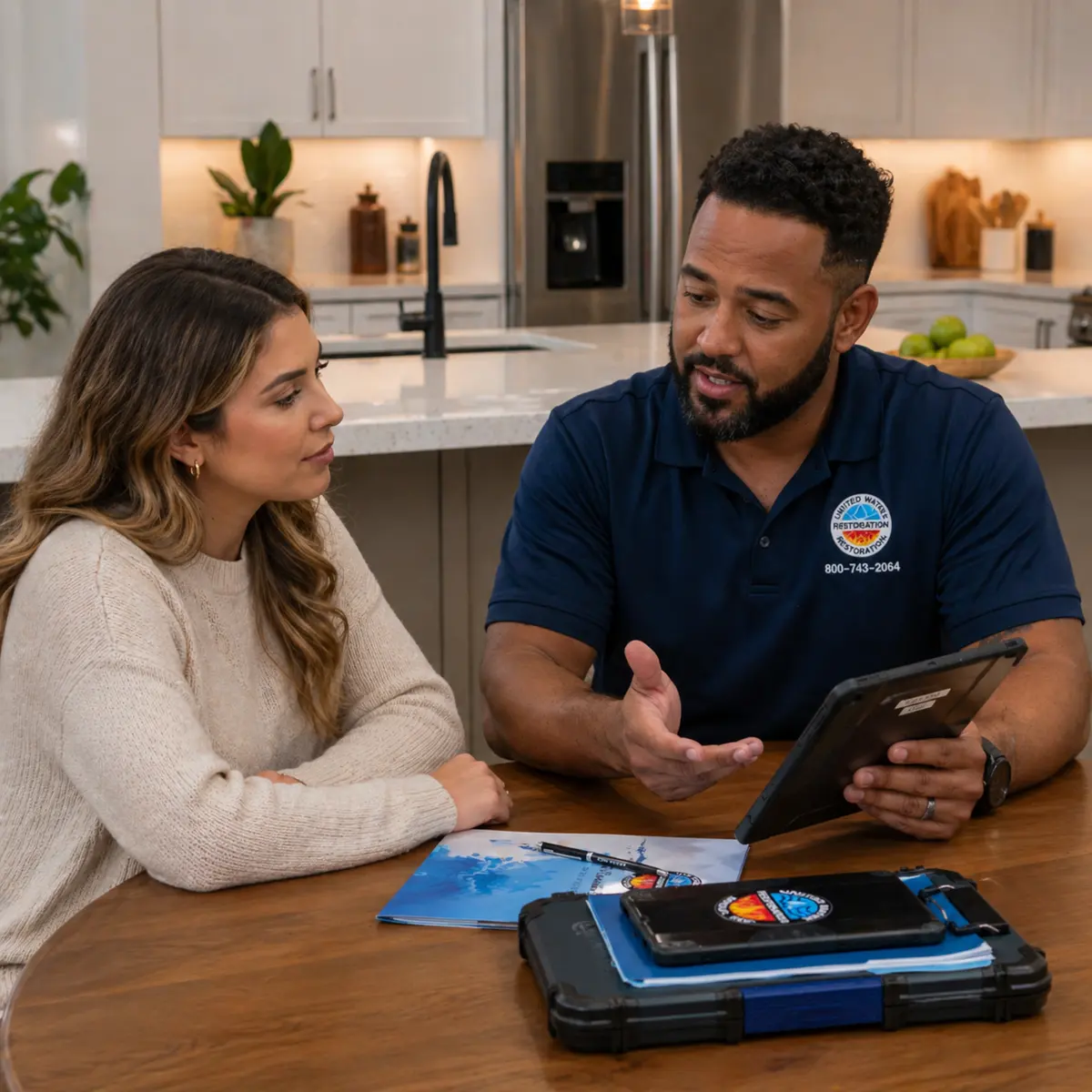
Most restoration companies stop when the building is dry and hand you a list of contractors. We do not. The same Central Florida company that opened the wall closes it again — drywall, texture, paint, trim, flooring, cabinetry, roofing and everything the damage took out. That matters more than it sounds: when mitigation and rebuild sit under one contract, nobody is waiting on a second company to schedule, and nobody is arguing about who owns the part in the middle.
- Drywall, texture and paint matched to what was there
- Flooring — tile, luxury vinyl plank, laminate, carpet and hardwood
- Kitchen and bathroom cabinetry, countertops and fixtures
- Roof repair and replacement after storm damage
- Trim, doors, and the fiddly finish work that decides whether a repair is invisible
- One contract, one schedule, one company answering for the result
The Handoff That Does Not Happen
The worst week of most restoration jobs is the one after the equipment leaves. The mitigation company is finished, the rebuild has not started, the adjuster is waiting on a scope from somebody who has not seen the property, and the homeowner is living in a house with no floor. That gap is not inevitable — it exists because two companies are each waiting on the other.
When it is one company, the rebuild scope is written while the drying equipment is still running, materials are ordered against a known dry-out date, and the crew that closes the wall already knows what is behind it. It is a scheduling advantage more than a technical one, and it is usually worth weeks.
Matching What Was There
Nobody wants a repair that reads as a repair. Getting there means finding the actual tile run or plank line rather than something close, matching a knockdown or orange-peel texture by hand, and being honest when a discontinued material genuinely cannot be matched. In a house where the same flooring runs through several rooms, that conversation about where a transition can legitimately go is worth having early.
Where a match is impossible, that is a coverage conversation with your carrier rather than something we quietly paper over. Florida policies vary widely on how they treat matching, and it is better to raise it in week one than to discover it at the walk-through.
Permits, Inspections and Doing It Properly
Anything structural, electrical or plumbing gets permitted. Marion, Alachua and Brevard counties each run their own building departments with their own turnaround, and the municipalities inside them add their own — which is one of the reasons an office in each market is worth having. Permits also protect you at resale, when an unpermitted rebuild becomes somebody else’s inspection finding.
We pull what the work requires and schedule the inspections. If a repair does not need a permit, we will tell you that too rather than adding a line to the invoice for one.